

A day at Fig Tree Bay, an evening meal in Ayia Napa or a wander around Larnaca does not always need a hire car. Once you know how to use Cyprus buses, they can be an easy, affordable way to get around – especially for short coastal journeys when nobody fancies being the designated driver.
The key is to treat the bus network as a useful holiday tool rather than a door-to-door service. It works well for main resorts, town centres and popular beaches. It is less reliable for remote villas, late-night plans and spontaneous trips into the countryside. A little planning makes all the difference.
How to use Cyprus buses in holiday areas
Cyprus has several local bus operators, each covering a different district, alongside intercity services between the main cities. In the Famagusta area, local buses serve places such as Protaras, Pernera, Kapparis, Paralimni and Ayia Napa. Other networks cover Larnaca, Limassol, Paphos and Nicosia.
Start by identifying the nearest proper bus stop to your accommodation, not just the nearest point on a map. In resort areas, stops are often on the main road rather than outside a quieter side street or residential development. From a villa in Pernera or Protaras, for example, a short walk to the coastal road can open up regular services towards Ayia Napa and Paralimni.
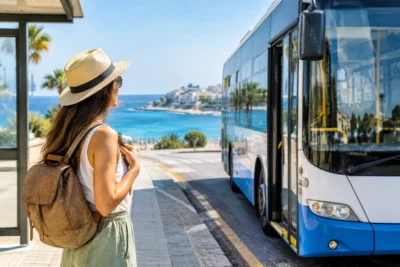
At the stop, check the route number and destination shown on the bus before boarding. The same road may carry buses going in both directions, and the display is more useful than assuming every bus follows the same route. If you are unsure, ask the driver politely before getting on. A simple “Does this go to Ayia Napa?” is perfectly normal.
It is also wise to signal clearly as the bus approaches. Stand where the driver can see you and raise your hand. Do not assume it will stop automatically, particularly at a quieter stop.
Routes: local, intercity and airport connections
For most visitors, local buses are best for short resort hops. They are particularly handy for travelling between Protaras and Ayia Napa, reaching WaterWorld in Ayia Napa, visiting Paralimni, or getting from central Larnaca to beaches and nearby neighbourhoods. In the eastern resorts, routes commonly run along the main tourist roads, although exact route numbers and stopping patterns can change.
Intercity buses are better for longer day trips between major places such as Larnaca, Limassol, Paphos and Nicosia. They can offer good value, but they are not designed around every holiday timetable. A trip from a coastal resort may involve first catching a local bus to a city or transport point, then changing to an intercity service.
Airport buses are a separate consideration. Larnaca Airport has bus options to several towns and cities, but a late arrival, lots of luggage or a property in a quieter location can make a pre-arranged transfer the more comfortable choice. Paphos Airport also has public transport connections, although they will not suit every flight time or final destination.
For a beach holiday based in Protaras, a bus is excellent for a car-free day in Ayia Napa. For a full-day trip to the Troodos mountains, a hire car or organised excursion is usually more practical. That is not a failing of the buses – Cyprus is a spread-out island, and mountain villages are not served like city suburbs.
Check times on the day you travel
Bus timetables in Cyprus can vary by season, day of the week and public holiday. Summer services in popular resorts are often more frequent, while winter schedules may be reduced. Evening services can also finish earlier than visitors expect, especially outside the busiest areas.
Before leaving your accommodation, check the current timetable through the relevant local operator or a current journey-planning app. Google Maps can be useful as a starting point, but use it with care. A listed stop or departure time is not a guarantee, particularly during seasonal timetable changes.
Give yourself a sensible buffer for dinner reservations, airport transfers and boat trips. If a restaurant booking is important, aim for the bus before the one that appears to get you there just on time. On warm days, delays feel longer when you are waiting in the sun with children or beach bags.
For the journey home, check the last bus before you set off. Take a screenshot of the timetable if your mobile signal is patchy, and make a note of the stop name or a nearby landmark. It is surprisingly easy to forget where you got off after a relaxed evening by the sea.
Fares and paying on board
Local bus travel is generally one of the cheaper ways to move around Cyprus, but fares, ticket types and payment methods can change. Some services sell tickets directly on board, while day, weekly or multi-journey options may be available depending on the operator and area.
Carry some small euro notes and coins if you plan to pay the driver. Even where other payment methods are available, cash avoids an awkward start to the journey. Tell the driver where you are going if there is any doubt about the fare, then keep your ticket until you have finished travelling.
A day ticket can be worthwhile if you expect to make several journeys, perhaps beach-hopping from Protaras to Ayia Napa and returning after dinner. For one outward trip and one journey back, a single ticket may be the simpler option. Do not buy a longer pass just because it sounds economical – work out how many bus rides you are genuinely likely to take.
Children’s fares, concessions and luggage rules differ between operators, so check the current details before relying on them. Foldable pushchairs are normally much easier to manage than large buggies, especially on busy summer buses.
What buses are like in practice
Most holiday buses are straightforward and air-conditioned, though comfort depends on the time of day and the route. A bus leaving a popular beach area around sunset may be busy, with sandy feet, inflatables and tired children all heading in the same direction.
If you are travelling with a pram, mobility aid or plenty of luggage, avoid the busiest times where possible. Board patiently, allow passengers to get off first and keep bags out of the aisle. Offering your seat to someone who needs it more is always appreciated.
Drivers keep to a schedule as best they can, but traffic around Ayia Napa, Larnaca and Limassol can affect the journey. There may be no announcement for every stop, so follow your position on your phone and press the stop button in good time. If in doubt, sit nearer the front and ask the driver to let you know when you reach your stop.
A few local tips that save hassle
Use buses for the journeys they do best: resort centres, beaches, shopping streets and relaxed evenings where you would rather not drive. Pair them with walking for the final stretch. Many of Cyprus’s nicest coves, promenades and tavernas sit a short distance from the main road, not beside a bus stop.
In summer, carry water and wear sun cream before walking to the stop. Shade can be limited, and a ten-minute walk feels different at midday. Keep a light layer for the bus itself, as air conditioning can be cooler than expected after the heat outside.
For groups of four or more, compare the total bus cost with a local taxi, particularly after dark or when travelling with young children. A taxi may cost more, but it can be better value in time and convenience for a single late journey. Conversely, a couple heading from Pernera to Ayia Napa for lunch can often save the car for another day and enjoy the freedom of the bus.
Choosing a stay with easy bus access
If you do not intend to hire a car, location matters more than almost anything else. Choose accommodation within an easy walk of a supermarket, restaurants and a main bus route. You will have far more flexibility than if every outing begins with a long walk along unlit roads.
This is one reason central Protaras, Pernera, Kapparis and parts of Ayia Napa suit car-free holidays well. They combine beaches, places to eat and useful local connections. ElloCyprus can help you find carefully selected villas and flats in the areas that fit the kind of holiday you want, with the reassurance of booking directly with a local team.
Cyprus buses are not meant to replace a car for every itinerary. Use them for the easy coastal days, plan ahead for the longer ones, and leave room for the occasional taxi home after a good meal. That balance gives you a more relaxed holiday and lets you enjoy the view rather than concentrating on the road.